Why Plus-Size Dresses Need Their Own Grading, Not a Scaled-Up Pattern
A curve dress is not a straight pattern scaled up. Bust, waist and hip change at different rates, so necklines gap and armholes bind. Curve grading starts from a dedicated plus-size block, with drape tested before bulk.
- Block: curve, not straight.
- Faults: neckline & armhole fixed at pattern stage.
- Fabric: 80–220 GSM; drape on the body.
- MOQ: 50 pcs/style/colour; ~7 days sample.
- Terms: 30% deposit, AQL 2.5.
Bottom line: build the block once, test drape, reorder on fit.
The Silent Fit Fault: Why Scaling a Pattern Fails
Plus-size fit is one of the few categories where the customer can tell within seconds whether the pattern was designed for her or enlarged from a size small. Two faults give it away: a neckline that stands away from the body, and an armhole that digs.
These are not sewing defects. A factory can hit every measurement on the spec sheet and still ship a dress that fits badly. The reason is that grading up a straight pattern adds width in fixed increments at fixed points, while the body does not widen that way. Bust, waist and hip change at different rates, and the relationship between shoulder width and bust circumference changes too.
The result is a dress that measures correctly and still fails on the body—the most expensive kind of fault, because it only shows up on the customer, after the photos, the marketing and the margin are already committed.
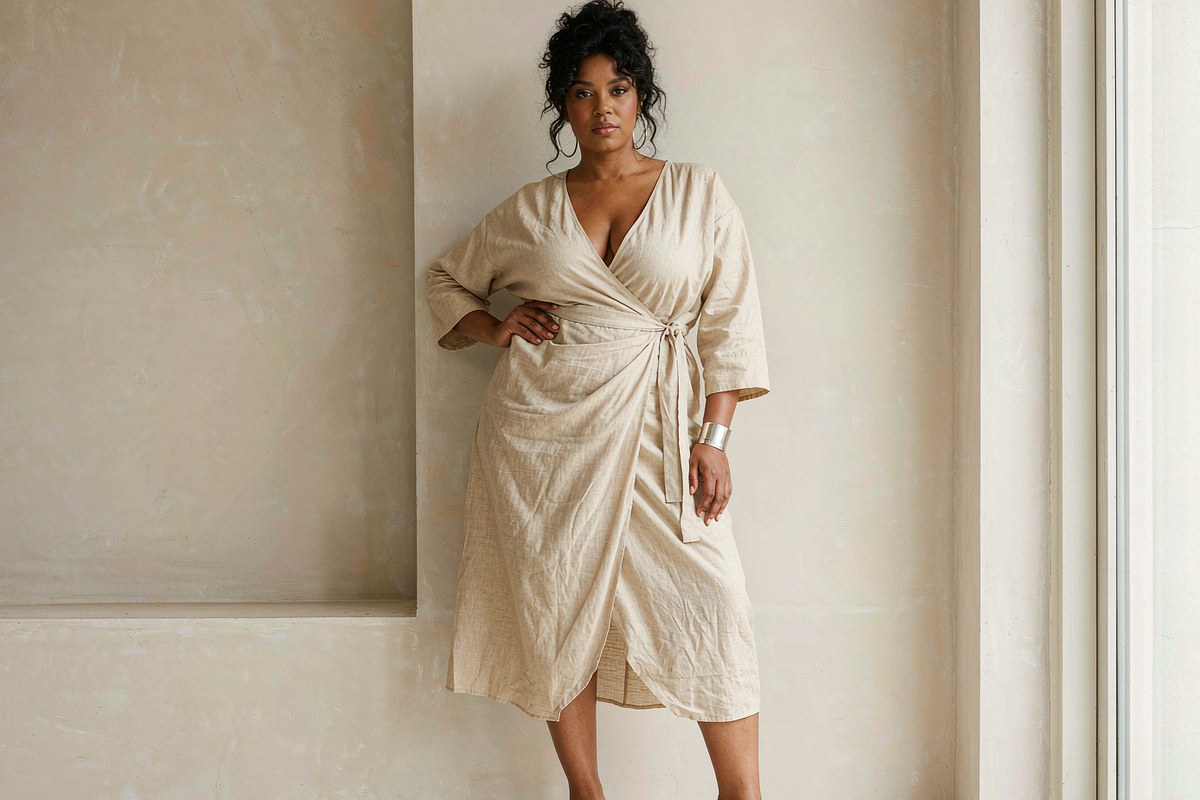
A wrap front that overlaps cleanly on a curve block: the neckline lies flat and the waist falls where the body actually narrows.
Scaled vs Re-Graded, Side by Side
The difference between a scaled pattern and a dedicated curve block is easiest to see dimension by dimension. This is the comparison we walk a buyer through before a curve collection goes into development:
| Dimension | Scaled-up straight pattern | Dedicated curve block |
|---|---|---|
| Bust / waist / hip | Same increment added at each point | Each area graded at its own rate |
| Neckline | Gaps as the shoulder-to-bust ratio shifts | Stabilised to lie flat across the range |
| Armhole | Digs or sits too low | Reshaped to clear the arm without binding |
| Waist position | Carried over from the straight block | Placed where the body actually narrows |
| Drape & coverage | Extrapolated from the small sample | Tested on the intended body before bulk |
| Re-order stability | Fit complaints recur with each size | Block is sealed; re-orders match the fit |
Note the last row. Curve grading is not only a first-order problem—a block that is developed properly becomes the reference for every re-order, which is where the commercial value actually sits.
How Curve Grading Works Here
Curve styles are graded from a plus-size block rather than from the straight block. Proportion is set for the range first, then each size is developed so balance holds: the neckline is stabilised so it sits flat, the armhole is reshaped so it clears the arm without binding, and the waist position is placed where the body actually narrows.
This is a pattern-making task, not a sizing-chart task. It happens before sampling, in the technical pattern team, and it is the reason a curve collection takes a slightly longer development window than the equivalent straight range—the extra work is in the block, not in the sewing.
We work to the buyer's size chart, whether that is US, EU or UK. There is no universal plus size; the block is developed against the actual measurements and grade rules of the range you intend to sell, then a reference sample is sealed so later orders can be measured against it.
The Tech Pack Checklist: Six Curve Grading Fields to Specify
A curve collection can only be as good as the spec behind it. These are the six fields we ask a brand to lock before a pattern is cut—missing any one of them is how a fit problem gets pushed downstream into sampling:
Bust / waist / hip grade rules
State the increment between sizes for each area separately. A single across-the-board grade is the classic cause of a gaping neckline.
Armhole depth & shape
Specify how the armhole changes across the range, not just at the base size, so it clears the arm without binding.
Back width & shoulder slope
Shoulder-to-bust ratio shifts with size; pin the back width and slope so the bodice does not tilt.
Waistline position
Mark where the waist sits on the body for each size, rather than carrying one vertical position through the range.
Fabric stretch & recovery
Note the weave, GSM and stretch direction. A fabric that recovers poorly will undo a well-graded block after washing.
Fit-model size & feedback
Name the size the sample is fitted on and how feedback is captured. Drape must be judged on the intended body.
A supplier who accepts a curve brief without asking for these fields is not re-grading—they are scaling, and the fit faults will surface on your customer.
Drape Testing on the Intended Body
Cotton-linen and other fluid fabrics behave differently across a wider pattern. A skirt that falls cleanly on a straight block can collapse or flare unexpectedly when the same fabric is spread across a larger area, and a wrap front that overlaps correctly at one size can pull open at another.
Curve styles therefore go through drape testing before bulk. The fabric is checked on the intended body so the fall and the coverage are verified, rather than being extrapolated from the straight sample. This is a physical check, not a measurement check—it is the only way to catch a panel that hangs badly or a closure that strains.
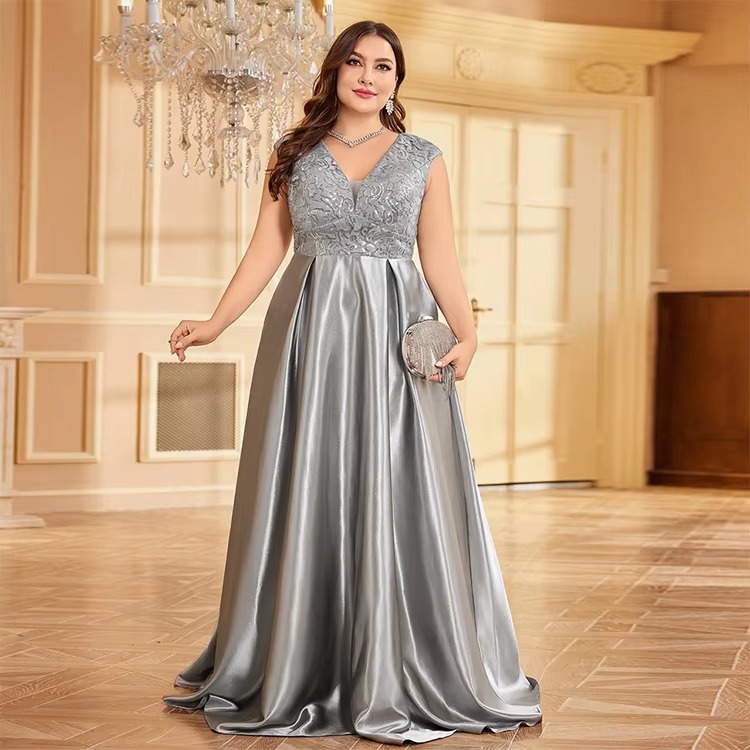
Heavier, fluid cloth changes how it falls across a curve pattern; drape and coverage are checked on the body before bulk.
Fabric & GSM for Curve Dresses
The fiber sets the floor for how a curve dress behaves. CHURELLE works in a GSM band of 80–220 for woven dress cloth, and the choice changes how a plus-size silhouette holds its shape:
| Curve use case | GSM band | Weave / fiber | Why it matters |
|---|---|---|---|
| Resort wrap & vacation | 120–150 | Plain cotton-linen | Airy and fluid; needs a tested overlap |
| Everyday & boutique | 150–180 | Plain cotton | Wash-stable structure that holds a graded line |
| Structured & occasion | 170–220 | Twill / satin weave | Supports an A-line and larger sizes without clinging |
The exact grammage is confirmed before dye, because it changes both hand-feel and cost. For a curve range, the rule is simple: a block that is graded correctly can still be let down by a fabric chosen only for how it looked on a small sample.
The Commercial Argument: Returns Are the Real Metric
Returns are the hidden cost of inclusive sizing done cheaply. A gaping neckline or a binding armhole is a fit complaint, and fit complaints are rarely exchanged for the same style in a different size—they end the relationship with the style and often with the label.
Developing the curve block properly costs one development cycle. Getting it wrong costs the category: the return rate climbs, the reviews turn, and a range that should have been a growth line becomes a write-off. For a brand building an inclusive collection, the block is an asset—it is reused across colours, prints and seasons once it is sealed.
That is why we treat curve development as a pattern task first and a production task second. The sample is the output of the block, not the place where the block gets improvised.
Why a Scaled Pattern Passes Measurement and Fails Fit
The failure mode is worth stating plainly because it is so easy to miss. A straight pattern scaled up through the sizes will match the numbers on a spec sheet: the bust, waist and length all measure where they should. What the tape measure cannot see is the relationship between those points—the shoulder-to-bust ratio, the armhole angle, the point where the waist actually narrows.
That is why fit faults are called silent: they pass inspection and surface only on the customer, as a neckline that will not lie flat or an armhole that restricts movement. Closing that gap is exactly what a dedicated curve block does, and it is the reason we treat pattern development as the decisive stage of an inclusive range.
Curve Grading FAQ
Can you just scale up a straight pattern for plus sizes?
Not if you want the fit to hold. Bust, waist and hip change at different rates, so a uniformly scaled pattern produces a gaping neckline and a binding armhole. A dedicated curve block grades each area at its own rate and is the only reliable route.
What is the largest size you can grade to?
We work to your size chart—US, EU or UK—and develop the block across the range you intend to sell. Tell us the size set and grade rules and we will confirm what is developable at sampling rather than guessing a universal "plus" size.
Do you need a plus-size fit model for testing?
Yes. Drape and coverage are checked on the intended body before bulk; a curve sample judged only against a straight fit model cannot reveal a panel that hangs badly or a closure that strains.
How much does curve grading add to the cost?
The extra work sits in pattern development, not in sewing: a dedicated block takes a longer development window than an equivalent straight range. The exact figure depends on the style, fabric and size set, so we break it out in the quote after seeing the tech pack rather than quoting a generic surcharge. MOQ stays at 50 pieces per style per colour.
Bottom Line
Inclusive sizing is won or lost in the pattern, not on the size label. If a dress is graded by scaling a straight block, it will measure correctly and fit badly—and the customer will notice in seconds. Specify the six curve fields in the tech pack, develop a dedicated block, test the drape on the intended body, and validate on a low-MOQ run before the season depends on it.
Planning a curve or inclusive dress range?
Send your size chart, grade rules and a sketch. We return a broken-down quote with the curve block plan and MOQ within 24 hours.
Discuss a Curve Collection